
The businesses that cross borders in 2026 aren’t the biggest ones — they’re the most deliberately designed ones. Scaling globally is no longer about capital. It’s about clarity.
There was a time when “going global” meant massive budgets, foreign offices, and a five-year roadmap that only Fortune 500 companies could afford to execute. That era is over. In 2026, a solo founder in Meerut can reach customers in Manchester. A two-person creative studio in Lagos can serve clients in Los Angeles. The infrastructure for global reach is now democratized — but knowing how to scale without burning out or breaking apart is the real competitive edge.
This isn’t a guide for billion-dollar companies. This is for the builder who’s seen local traction and is now asking the right question: what comes next?
Why 2026 is a Pivot Year
We’re sitting at an unusual inflection point. Three forces have converged simultaneously: AI-powered automation has slashed the cost of execution, remote-first infrastructure has normalized cross-border teams, and consumer expectations have globally standardized at a speed no previous generation experienced. Your customer in Delhi and your customer in Dublin want the same thing — speed, personalization, and trust
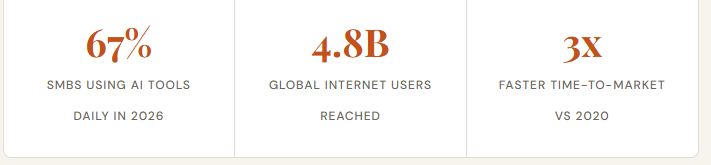
The window to act is open, but it won’t stay wide forever. As platforms mature and competition catches up, first-mover advantage in underserved global niches is compressing. The businesses scaling smart right now are locking in the positions that latecomers will spend years trying to reclaim.
The Foundation: Know What You're Actually Selling
Before a single international ad runs, before a second language is added to your website, you need ruthless clarity on your value proposition stripped of cultural context. What problem do you solve? Not in your city’s language — in universal terms. Can you explain your product’s core benefit in one sentence to someone who has never heard of your industry?
Most businesses that fail at global expansion aren’t defeated by logistics or language barriers. They’re defeated by ambiguity. They brought a locally-understood product to a market that had no frame of reference for it — and they expected the market to figure it out. It never does.
"Scale doesn't create clarity. It amplifies whatever foundation you already have — flaws included."
Do the hard work locally first. Validate that your message lands with strangers, not just people who already know you. Build a repeatable acquisition system — even a basic one — before you replicate it across borders. The goal isn’t to internationalize complexity; it’s to internationalize something that already works simply.
The Five Pillars of Smart Global Scaling
Translation is the minimum. True localization means understanding what motivates a buyer in your target market. Payment preferences, trust signals, cultural sensitivities around pricing, and even color psychology differ dramatically by region. A checkout page that converts 8% in India might convert 1.5% in Germany with identical copy but different UX patterns.
In 2026, content is no longer a nice-to-have — it’s the primary discovery mechanism in most global markets. An AI-assisted content strategy, built around genuine insight and your unique perspective, compounds over time. A blog post written today can drive customers from five countries over the next three years. Invest in building this engine early.
Cold-entering a new market alone is expensive and slow. Local partners — whether distribution channels, co-marketing relationships, or even micro-influencers — compress your time to trust significantly. They know the regulatory landscape, the local competition, and the cultural shortcuts that would take you years to map on your own.
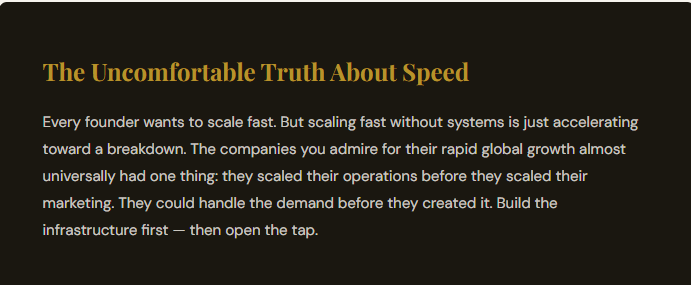
The operational strain of serving multiple time zones, currencies, and languages hits founders unexpectedly. The businesses that scale sustainably are the ones that over-automated early — not just for efficiency, but for sanity. Customer support workflows, invoicing, onboarding sequences, and reporting should be largely self-running before you add the weight of a global audience.
Aggregate metrics hide dangerous patterns. A product might be growing overall while quietly dying in one of its most promising markets. Build your analytics to segment by geography from day one. Understand retention, churn, and lifetime value by region — not just as a whole — so you can double down where you’re winning and triage where you’re not.
The Mindset Shift That Changes Everything
Perhaps the most underrated element of successful global scaling is psychological. Local success creates local thinking. You start optimizing for the market you know, the customers you can meet, the problems you can touch. Going global demands that you start making decisions for people you’ve never met, in cities you may never visit, solving problems you learned about through data rather than conversation.
This requires trust in systems over intuition. It requires hiring or partnering with people whose judgment you’ll need to respect across cultural distances. It requires accepting that your product will be used in ways you never anticipated, adapted to contexts you didn’t design for — and that this is a feature, not a failure.
The builders who scale globally aren’t the ones who figure out every detail before they begin. They’re the ones who build strong enough foundations that the unexpected doesn’t destroy them — and curious enough minds that the unexpected actually excites them.
Start Narrow, Scale Wide
The counterintuitive secret to global scaling is radical focus in the early stages. Don’t try to be everywhere. Pick one secondary market, enter it with intentionality, and build a playbook from that experience. The systems you develop, the mistakes you make, and the customers you earn in your first international market become the manual for every market that follows.
Amazon didn’t go global at once. Spotify didn’t launch in 183 countries on day one. The brands that look omnipresent today spent years being quietly deliberate about sequence and priority. Your global strategy should read like a roadmap, not a wish list.
The world isn’t waiting for you to be ready. But it will reward you for being prepared.